
Onlay and Inlays Parker, CO
A healthy tooth is remarkably strong, yet even the most resilient enamel can be compromised by decay, fractures, or wear. When damage occurs, choosing the right type of restoration makes a meaningful difference in comfort, longevity, and appearance. At Parker Dental Implant and Specialty Center our prosthodontist focuses on advanced restorative solutions that preserve as much natural tooth structure as possible, while delivering strength and lifelike beauty. Porcelain inlays and onlays are two of those solutions, offering a conservative and highly precise way to restore damaged teeth.
Fillings
Dental fillings are commonly used to treat cavities and minor tooth damage. After removing decay, the area is cleaned and filled with a restorative material to rebuild the tooth’s structure and prevent further bacterial invasion. Traditional fillings are often made from composite resin or amalgam and are appropriate for small to moderate areas of damage. However, not all cavities or fractures are ideal for a standard filling. When a damaged area is too large for a direct filling but does not require a full dental crown, a more customized and durable option may be recommended. This is where inlays and onlays become valuable. These restorations are designed outside the mouth and bonded into place, providing greater precision and strength than a conventional filling.
What Are Inlays?
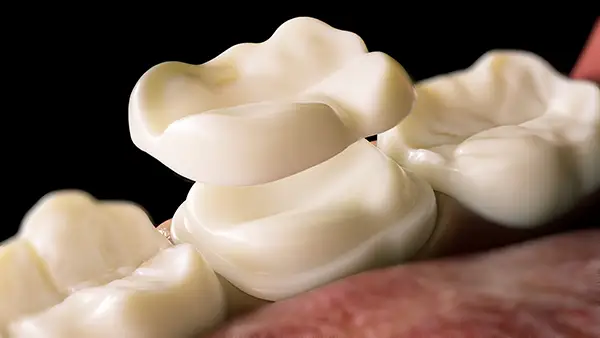
An inlay is a custom-crafted restoration that fits within the grooves of a tooth, typically between the cusps, or raised points, of a molar or premolar. It is used when decay or damage is too extensive for a simple filling but has not weakened the cusps themselves. Inlays are fabricated in a dental laboratory using detailed impressions or digital scans of the prepared tooth. Because they are created outside the mouth, they can be designed with exceptional accuracy. Once completed, the inlay is bonded securely into place, restoring the tooth’s shape, strength, and function.
Inlays are often recommended when:
- A cavity is too large for a traditional filling
- The tooth structure between cusps has been compromised
- An older filling has failed and needs replacement
- There is moderate damage without cusp involvement
- By preserving more natural tooth structure than a crown, inlays offer a conservative and long-lasting solution for targeted restoration.
What Are Onlays?
An onlay is similar to an inlay but covers a larger portion of the tooth. While an inlay fits within the cusps, an onlay extends over one or more cusps. For this reason, onlays are sometimes referred to as partial crowns. Onlays are used when the damage extends to the cusps of the tooth but does not require full coverage with a crown. Like inlays, onlays are custom-made and bonded into place, reinforcing weakened areas while maintaining as much healthy structure as possible.
Onlays may be recommended when:
- One or more cusps are fractured or weakened
- Decay extends beyond the center grooves of the tooth
- A large filling has compromised structural integrity
- A crown would remove more healthy tooth structure than necessary
- Because they restore the biting surface and strengthen weakened cusps, onlays are particularly beneficial for molars that endure significant chewing forces.
The Process Of Receiving An Inlay Or Onlay
The process begins with a comprehensive evaluation. Our prosthodontist, Dr. Isra Ahmed, carefully examines the affected tooth, evaluates surrounding structures, and determines whether an inlay, onlay, or crown is the most appropriate solution. After removing decay or damaged areas, the tooth is conservatively shaped to receive the restoration. Digital scans or impressions are taken to ensure a precise fit. A temporary restoration may be placed while the final porcelain piece is being fabricated. At the placement appointment, the inlay or onlay is carefully bonded to the tooth using strong dental adhesives. The fit is checked, the bite is adjusted if needed, and the restoration is polished to blend naturally with the surrounding enamel. The result is a secure, highly customized restoration that feels comfortable and functions like a natural tooth.
Why Use Porcelain?
Porcelain is widely regarded for its strength and aesthetic qualities, making it an excellent material for inlays and onlays. Unlike metal restorations, porcelain closely resembles natural enamel in both color and translucency. This allows restorations to blend beautifully with surrounding teeth.
- Beyond appearance, porcelain offers several functional advantages:
- Exceptional durability under chewing pressure
- Resistance to staining Biocompatibility with surrounding tissues
- Stability over time without expanding or contracting
- Porcelain also bonds effectively to tooth structure, which can help reinforce and strengthen the remaining enamel. Because it mimics the way natural teeth reflect light, porcelain restorations often appear virtually indistinguishable from untreated teeth.
For patients who prefer metal-free restorations, porcelain provides a highly aesthetic and reliable option.
Inlays And Onlays Vs. Crowns
In some cases, patients wonder why an inlay or onlay is recommended instead of a full crown. The key difference lies in how much of the natural tooth must be removed. A dental crown covers the entire visible portion of the tooth above the gumline. While crowns are an excellent solution for severely damaged teeth, they require more reshaping of healthy structure. Inlays and onlays, on the other hand, are more conservative. They restore only the areas that are damaged, allowing the majority of the tooth to remain intact. Preserving natural tooth structure is always a priority when clinically appropriate. By choosing an inlay or onlay when possible, we maintain strength, protect the integrity of the tooth, and support long-term oral health.
Long-Term Care And Maintenance
Porcelain inlays and onlays are designed for longevity, but their success depends on proper care. Maintaining good oral hygiene is essential. Daily brushing, flossing, and routine professional cleanings help prevent recurrent decay around the restoration. Patients should also avoid using their teeth as tools to open packages or bite hard objects. If teeth grinding or clenching is a concern, a custom nightguard may be recommended to protect both natural teeth and restorations. With appropriate care and regular dental visits, porcelain inlays and onlays can provide many years of reliable performance.
Advanced Restorative Care In Parker, CO
At Parker Dental Implant and Specialty Center, restorative dentistry is approached with precision and attention to detail. Dr. Isra Ahmed is trained in the complex art and science of rebuilding teeth to achieve optimal function and aesthetics. Porcelain inlays and onlays allow us to restore strength while preserving natural tooth structure whenever possible. If you have a damaged or weakened tooth and would like to explore conservative, long-lasting options, we invite you to schedule a consultation with us by calling (720) 522-2000. Our team is committed to delivering personalized restorative solutions designed to protect your oral health and support a confident smile.