CT-Guided Dental Implant Placement Parker, CO
Every dental implant placement begins with a plan. The quality of that plan determines everything that follows, from how well the implant integrates with the jawbone to how natural the final restoration looks and functions. At Parker Dental Implant and Specialty Center we use CT-guided dental implant placement to bring an extraordinary level of accuracy to every case. This technology allows our prosthodontist to map your anatomy in three dimensions, design your treatment digitally, and place your implant with precision that simply was not possible with older methods. The result is a more predictable procedure, a smoother recovery, and a restoration built to last.
What Is CT-Guided Implant Placement?
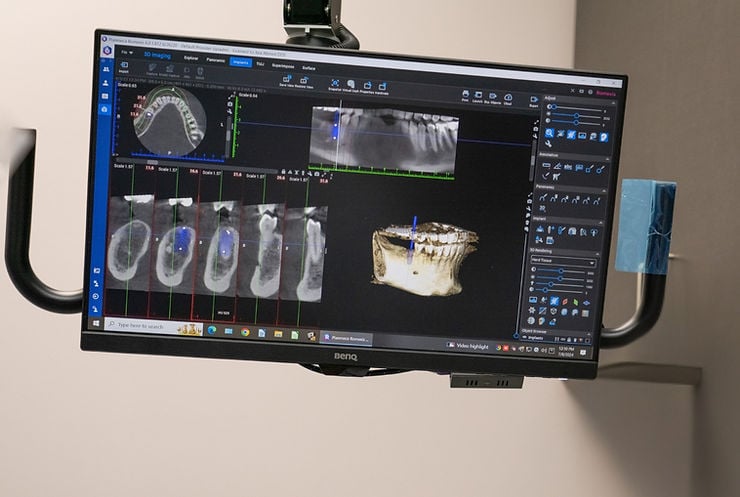
CT-guided implant placement combines cone beam computed tomography (CBCT) imaging with advanced surgical planning software to design and execute implant placement with sub-millimeter accuracy. Unlike traditional two-dimensional X-rays, a CBCT scan captures a full three-dimensional image of your jaw, teeth, bone, and surrounding structures. This gives Dr. Isra Ahmed a comprehensive view of your unique anatomy before a single step of treatment begins.
Using that 3D data, the precise position, angle, and depth of each implant is planned digitally. In many cases, this planning process generates a custom surgical guide, a precisely fabricated device that fits over your teeth or gums and directs the placement instrument to the exact location mapped during planning. The result is implant placement that matches the pre-surgical plan with a high degree of accuracy.
How the Process Works
CT-guided implant placement follows a clear, patient-centered sequence.
CBCT Imaging
A low-radiation cone beam scan is taken of your jaw. This scan is completed in under a minute and produces a detailed 3D model of your bone volume, density, and anatomical structures, including nerves and sinuses.
Digital Treatment Planning
We use specialized software to evaluate the scan and map the ideal implant position. Factors such as bone quality, restoration goals, and bite alignment are all considered during this phase.
Surgical Guide Fabrication
Based on the digital plan, a custom surgical guide is designed and milled. This guide fits precisely over your existing teeth or gum tissue and directs the placement instrument to the pre-planned site with accuracy the human hand alone cannot replicate.
Guided Implant Placement
On the day of surgery, the surgical guide is seated in your mouth and the implant is placed through it, following the exact path established in the digital plan.
Healing and Restoration
After placement, the implant integrates with the jawbone over a period of weeks to months. Once integration is confirmed, we will complete the restoration with a custom crown, bridge, or prosthesis.
How Long Does the Process Take?
The imaging and planning phase typically takes one to two weeks from scan to surgical guide delivery, depending on case complexity. The surgical appointment itself is often shorter than patients expect. Because the guide eliminates much of the intraoperative decision-making, placement is efficient and the procedure frequently requires less time than traditional freehand surgery.
For straightforward single-implant cases, the guided placement appointment may take under an hour. More complex cases involving multiple implants or bone considerations will take longer, and our prosthodontist will give you a clear timeline during your consultation.
Recovery from CT-guided placement is typically similar to, or easier than, traditional implant surgery, with most patients returning to normal activity within a day or two.
CT-Guided Placement vs. Freehand Implant Surgery
Traditional freehand implant placement relies on the surgeon’s experience, two-dimensional imaging, and real-time judgment during the procedure. Skilled clinicians achieve excellent results with this approach, but it introduces variables that CT-guided planning is designed to eliminate. There are many advantages of CT-guided placement.
Greater Positional Accuracy
Studies consistently show that guided placement reduces deviation from the planned implant position compared to freehand surgery. Dental implants placed at the correct angle and depth function better and are easier to restore.
Improved Safety
Identifying the exact location of nerves, blood vessels, and sinuses before surgery significantly reduces the risk of inadvertent contact with these structures during placement.
Better Restorative Outcomes
Because placement is driven in part by the final restoration design, the implant emerges at the ideal position for a crown or prosthesis that looks and functions naturally.
Reduced Surgical Time
With a physical guide directing placement, the procedure tends to move efficiently, which often means less time under anesthesia and a more comfortable experience overall.
Confidence in Complex Cases
Multiple implants, limited bone volume, and proximity to anatomical landmarks are all managed more safely when the entire case has been visualized and rehearsed digitally before the first incision.
Who Is a Candidate for CT-Guided Implant Placement?
Most patients seeking dental implants are candidates for CT-guided placement. The approach is particularly valuable for patients with limited bone volume, those requiring multiple implants, patients with complex anatomy such as low sinus floors or closely positioned nerves, and cases where precise angulation is critical to the final prosthetic result. During your evaluation, Dr. Isra Ahmed will review your CBCT scan and discuss whether guided placement is appropriate for your specific situation.
Experience Implant Placement Designed Around You
CT-guided dental implant placement represents a meaningful advancement in how implants are planned and delivered. By combining detailed 3D imaging with digital surgical planning and precision-fabricated guides, our prosthodontist is able to place implants with a level of accuracy that supports long-term success and a restoration that truly fits your life.
If you are considering dental implants in Parker, CO, we invite you to schedule a consultation at our implant and specialty center. We will evaluate your anatomy, walk you through the CT-guided process, and develop a treatment plan built around your goals. Contact our office today by calling (720) 522-2000. Take the first step toward a complete, confident smile.